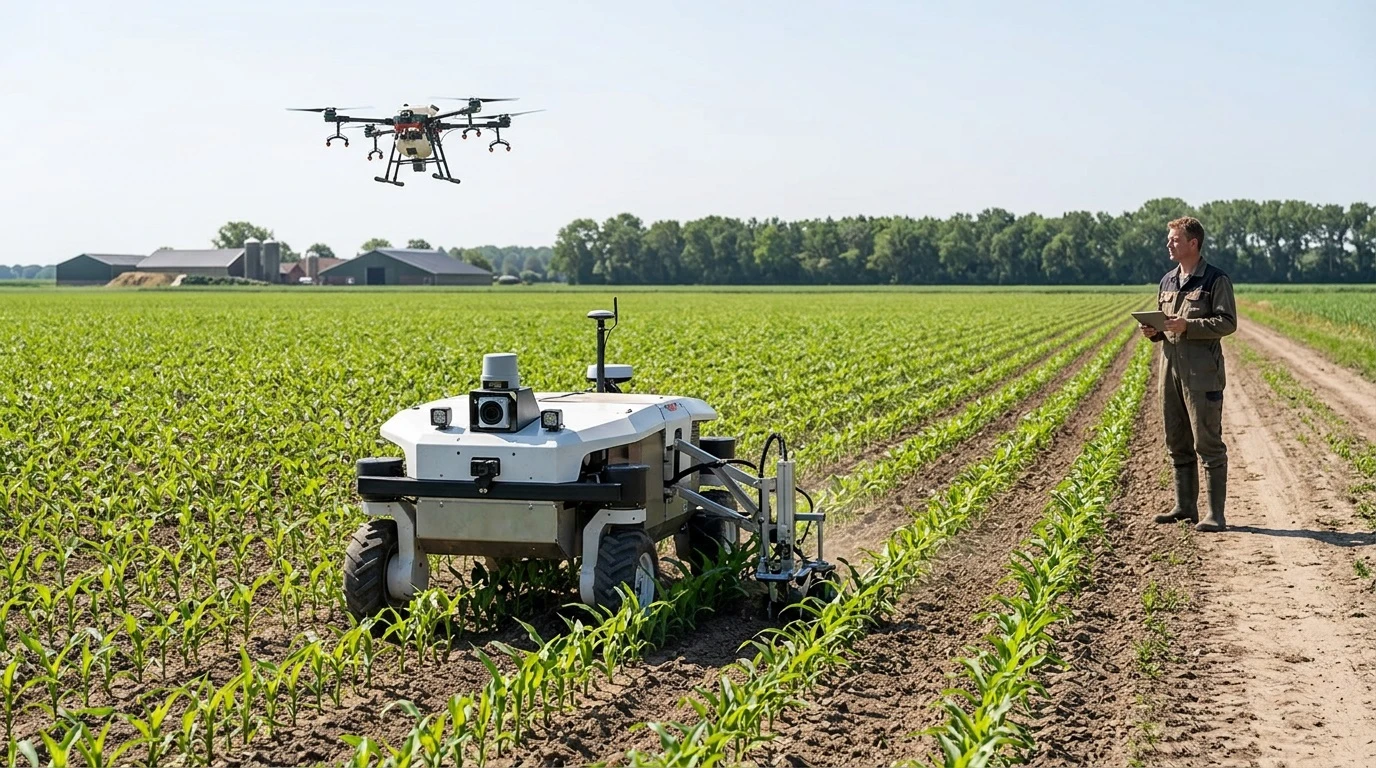
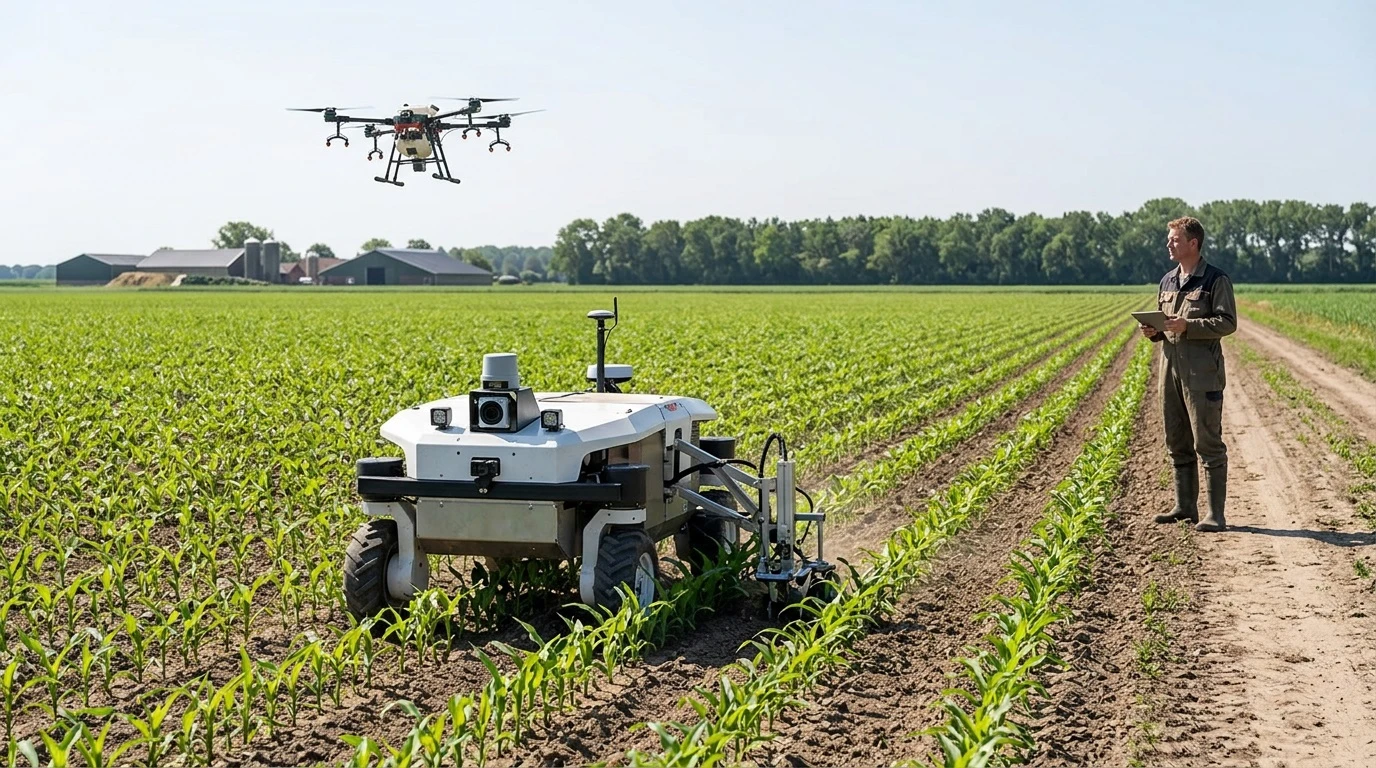
Modern agriculture faces a difficult balance: growers must protect yield, reduce waste, manage labor shortages, and respond faster to weather, pests, and input costs, often with limited time for field scouting and analysis. That is why AI in agriculture is attracting attention across crop production, not as a replacement for agronomy, but as a way to turn images, sensor readings, and field records into faster and more targeted decisions. This guide explains how AI is being used in practice, what problems it solves well today, and how farmers and agribusiness teams can adopt it without falling into the trap of expensive, disconnected pilot projects.
“AI should be a tool for agrifood system transformation and rural development.”
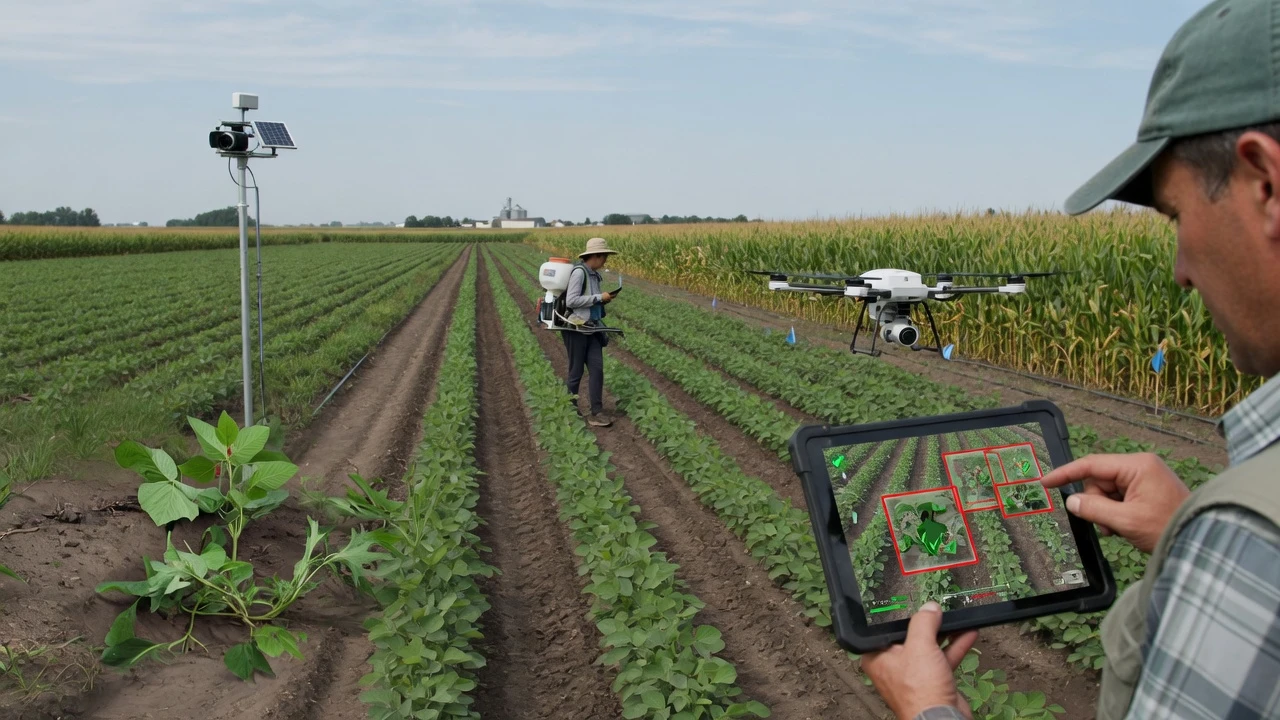
Table of Contents
Why AI matters
AI matters in agriculture because the sector is dealing with climate pressure, resource scarcity, labor constraints, and the need to produce more with tighter operational control. Traditional farming methods often rely on manual observation, fixed schedules, and experience-based judgment, which can lead to inefficient resource use and delayed response to stress, pests, or nutrient problems. By contrast, AI systems use sensor data, imagery, and machine learning models to support precision farming, real-time monitoring, and data-driven decision-making.
FAO’s digital agriculture work frames this shift as part of a broader transformation toward more efficient, resilient, and sustainable agrifood systems. The 2025 FAO roadmap also stresses that progress will depend on moving beyond fragmented pilots toward collaboration, reuse, contextual adaptation, and measurable impact. That point is important because AI in agriculture is often misunderstood as a collection of tools, when its real value comes from connecting monitoring to action.
The practical case for AI is strongest where the cost of delay is high. If weeds are detected late, they compete for water, nutrients, and light; if disease symptoms are missed early, treatment windows narrow; and if irrigation or fertilization stays uniform across a variable field, inputs are often wasted. AI helps reduce that delay by identifying patterns faster than manual workflows can, especially when farms are already collecting images or sensor data.
Core applications
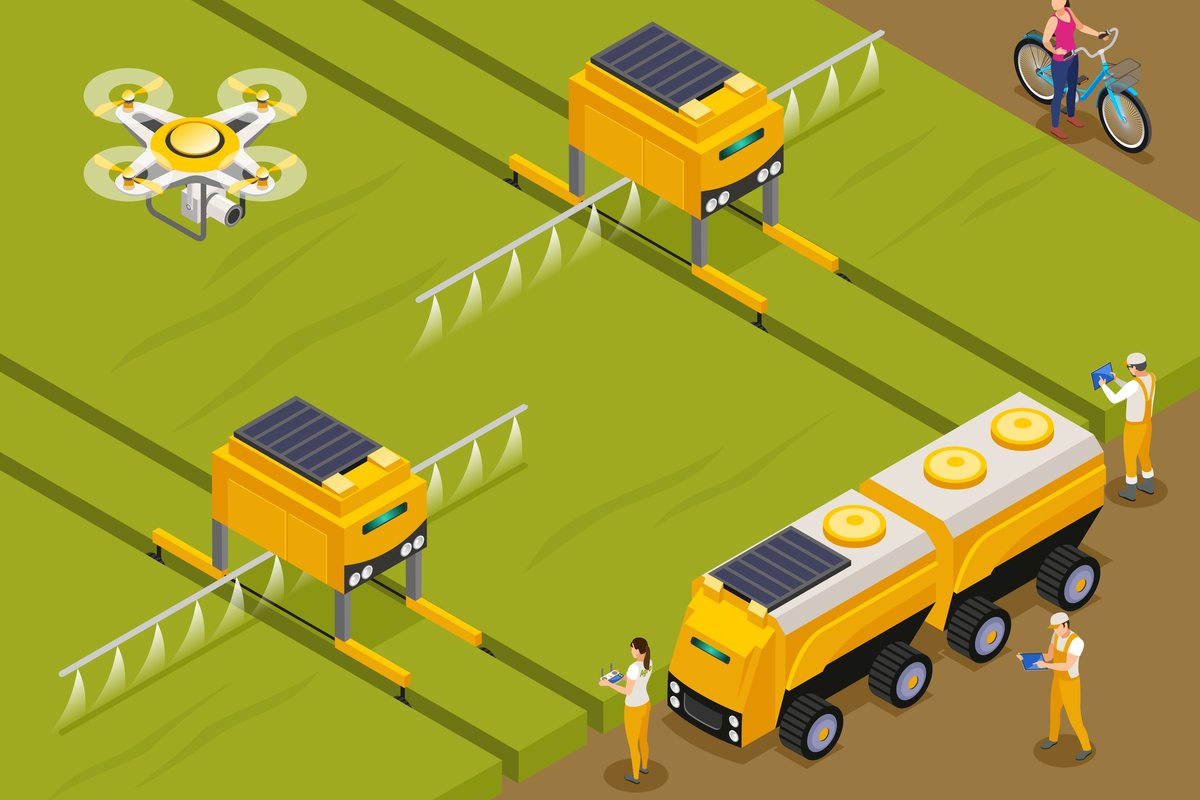
Weed detection is one of the clearest examples of AI delivering practical field value. A 2023 systematic literature review found rapid growth in deep-learning-based weed detection research and showed that crop images for these systems are frequently captured using robots, drones, and cell phones, with RGB imagery used most often. The same review explains why growers care: manual weed scouting is expensive, difficult to manage, and based on sampling patterns that may miss infestations across the field.
Deep learning improves weed detection because it can learn features directly from images instead of depending only on handcrafted rules. The review identified 34 unique weed types, 16 image-processing techniques, and 11 deep-learning algorithms with 19 CNN variants across the weed-detection literature, showing how broad and active this application area has become. Reported results in the review include very high accuracies in task-specific studies, but the same literature also notes challenges such as light variation, overlapping leaves, field complexity, and the need for larger, more diverse datasets.
A newer 2026 review pushes the application even closer to field operations. It reported that state-of-the-art visual weed detection methods could cover 93 percent of weeds while spraying only 30 percent of the field area in one cited scenario, highlighting the potential for deep-learning-based precision spraying to reduce herbicide use and environmental impact. That does not mean every farm will achieve the same result, but it shows why weed detection is one of the most commercially relevant AI use cases in crop production today.
Crop monitoring is the second major application, and it usually relies on a mix of optical sensors, UAV imagery, satellite data, and AI-driven analytics. The 2025 systematic review on IoT and AI in agriculture found strong recent growth in optical, acoustic, electromagnetic, and soil sensors, alongside machine learning models such as CNNs, SVMs, and random forests for irrigation, fertilization, pest management, and crop monitoring. In practical terms, crop monitoring systems help growers observe plant growth, chlorophyll status, biomass trends, and field variability earlier than periodic manual scouting alone.
Disease and stress detection sit close to crop monitoring but solve a more urgent problem. Machine vision and AI-powered disease detection systems can help identify plant stress earlier, which supports targeted intervention before significant yield loss develops. FAO has also emphasized that digital tools can help farmers detect pests and diseases while optimizing the use of labour, fertilizers, pesticides, feed, and water, linking AI directly to climate resilience and farm efficiency.
Smart irrigation and fertilization are another core layer of practical AI use. Soil and water sensors provide real-time information on moisture, pH, temperature, and nutrient status, while AI models analyze these data streams alongside weather or crop-growth signals to support precision irrigation and site-specific fertilization. This matters because AI is most effective when it improves timing and placement, not just when it produces a dashboard.
The table below shows how these applications differ in field use.
| Application | Main data source | What AI helps detect or optimize | Why it matters |
| Weed detection | RGB images from robots, drones, and mobile devices | Weed presence, weed-crop separation, weed mapping, and targeted spraying opportunities | Reduces scouting burden and can support site-specific herbicide use instead of blanket application |
| Crop monitoring | Optical sensors, UAV imagery, satellite inputs, and field sensors | Variability in plant vigor, biomass, chlorophyll status, and crop-condition trends | Helps growers identify stress zones and prioritize field actions earlier |
| Disease detection | Machine vision, camera systems, and multisource sensing | Early signs of plant stress, disease symptoms, and intervention priorities | Faster detection can narrow losses and improve treatment timing |
| Irrigation and fertilization | Soil moisture, nutrient, pH, temperature, and weather-linked data | Water timing, nutrient placement, and site-specific input decisions | Improves efficiency and reduces waste of water and fertilizers |
Adoption roadmap
The best way to adopt AI in agriculture is to start with one decision problem, not one technology purchase. FAO’s recent roadmap argues for contextual adaptation and impact-focused implementation, and the 2025 systematic review reaches a similar conclusion by highlighting real-world deployment gaps despite rapid technical progress. In other words, farms should begin with the decision they want to improve, then select the data and tools that fit that use case.
A practical rollout usually follows six steps:
- Define the agronomic problem. Choose a clear use case such as weed escapes, disease hotspots, irrigation scheduling, or nutrient variability, because AI performs best when it addresses a specific operational question.
- Select the right data source. Weed detection often starts with RGB imagery, while irrigation and fertility decisions depend more on soil, water, and environmental sensing.
- Validate outputs in the field. Review literature repeatedly warns that field conditions such as lighting, connectivity, crop growth stage, and environmental variability can affect performance.
- Connect monitoring to action. A model has little value if it cannot trigger a clearer scouting route, spray decision, irrigation adjustment, or nutrient plan.
- Measure one outcome first. The first success metric may be reduced scouting time, better spray targeting, lower herbicide use, improved irrigation efficiency, or earlier stress detection rather than only yield.
- Scale only after integration works. FAO’s roadmap specifically argues against fragmented pilots and in favor of solutions that can be reused, trusted, and adapted to local context.
This staged approach is important because agriculture generates heterogeneous data from sensors, UAVs, satellite imagery, and farm software, and integrating those data into one decision framework remains complex. The same review identifies interoperability, standardization, and AI-driven data fusion as ongoing technical challenges. Farms that skip this integration step often end up with multiple tools that collect information but do not improve decisions.
Tool selection
Not every farm needs the same AI stack. Large operations may benefit from UAV-based imaging, broader remote sensing coverage, and cloud analytics, while smaller or resource-constrained farms may start with simpler in-field sensors or image-based tools that support localized management. The 2025 review explicitly notes that high-cost proprietary hardware, infrastructure limitations, and limited connectivity can restrict adoption, especially for smaller growers.
That makes tool selection a business decision as much as a technical one. Optical sensors are strong for above-ground crop monitoring and vegetation analysis, soil and water sensors are strong for in-situ irrigation control and nutrient balance, and electromagnetic sensing is valuable for soil characterization and site-specific management. UAV and satellite systems offer scale, but they often require more expertise, better data workflows, and more stable infrastructure.
A useful buyer checklist should include these questions:
- Does the tool solve a real field problem? AI is strongest where it improves a recurring decision such as scouting, spraying, irrigation, or fertilization.
- What data does it require? Image models, sensor models, and predictive systems each depend on different types and quality of data.
- How does it fit the workflow? Tools create value only when the farm team can act on the output without adding confusion or delay.
- Can the result be validated? Responsible use requires field checks, quality assurance, and human oversight.
- Is the infrastructure realistic? Connectivity constraints, cost, and technical support remain major barriers in open-field agriculture.